There are no items in your cart
Add More
Add More
| Item Details | Price | ||
|---|---|---|---|

Thu Nov 12, 2026 · by Kong
Only 2 out of 10 e-commerce products will ever win. That is not failure. That is normal. The sellers who give up are usually not the ones with bad luck. They are the ones who picked a product with nothing special about it, panicked when it didn't sell in the first few weeks, or held back on ads.
So when someone asks me what to sell on Shopee, I don't give them a "hot product list". Lists like that go stale in a month, and by the time you see one, thousands of other sellers have seen it too. What I give them is a way to choose a product, test it without betting the house, and find the two winners worth scaling.
This guide is for two kinds of sellers:
Both make the same mistake: committing to a product before checking whether it can win.
It used to be that the cheapest seller sold the most. That isn't how Shopee works any more. If you sell the exact same item, with the exact same copy-paste photo from your China supplier, as thousands of other sellers, then the only thing a buyer can compare is price. Whoever sells cheaper wins, and the price war keeps spiralling down until nobody has any margin left.
The brands that do well today do the opposite. They put money into products that are genuinely different, with a strong USP (unique selling point), and then they spend on content and awareness to shout about why theirs is better. Differentiation is what sells and survives long term.
That changes the question. Don't ask "what is everyone buying?" Ask "what can I sell that has a real reason to be chosen over the others?"
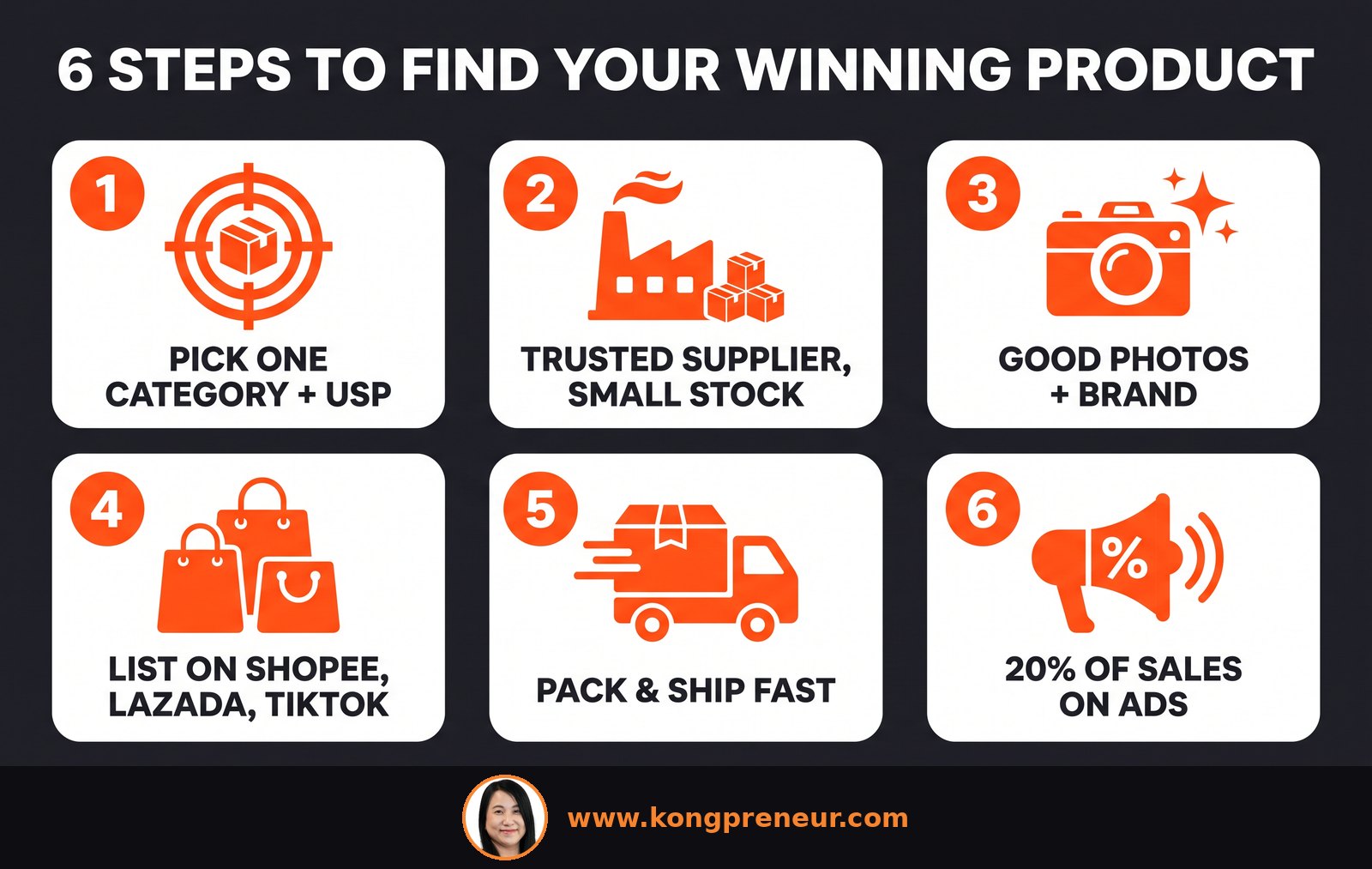
Here is the path I share with my students. It works for Shopee, Lazada and TikTok Shop alike:
📌 Found this useful? Save this infographic or share it with a friend who sells online: WhatsApp · Facebook · Pinterest
Choose one category, for example food or fashion, and stay focused on it at the start. Spreading yourself over five categories means you learn none of them properly. Inside that category, look for a product with a real USP, not just another generic item. Ask yourself: if a buyer sees my listing next to ten others, what is the one thing that makes them click mine?
The USP can be a better material, a size nobody else offers, a combination that solves a specific problem, or a brand story people connect with. What it cannot be is "same thing, slightly cheaper".
Work with reputable suppliers. 1688.com is where my students and I source at factory prices. Then start small. A first stock order of around RM3k to RM5k is enough to test whether a product moves, without locking all your cash into boxes sitting in your storeroom.
Your photos do the selling, because most customers today are too lazy to read long descriptions. Before you design anything, study your competitors: how they design their images and what promotion mechanics they use. Then make images that are not design-perfect but explain everything at a glance. Some image types that work well:
Basic Canva skills are enough to start. Beyond the listing, build your brand on social media: your founder story and your USP. That's what gives people a reason to remember you instead of the cheapest seller.
Never depend on just one platform. Each marketplace has its own buyers, and listing on all three shows you where your product sells best. If you are still learning the basics of setting up, my guide on how to sell on Shopee walks through what to focus on first.
When orders come in, pack them and ship them fast. Slow shipping leads to bad reviews and cancellations, and a new shop can't afford either. Speed is one of the few things a small seller can beat a big seller on from day one.
This is the step most people skip. Many sellers believe that once a product is listed, it will sell thousands of units organically. In reality, the sellers who do well invest a lot in marketing and Shopee Ads, roughly 15 to 20% of their monthly sales. I tell new sellers: aim for 20%, not less. If you want the detail on how to set that budget, read how much to spend on Shopee Ads.
And don't stop at ads. Shopee gives you many tools: livestream, Shopee Video, vouchers, gift-with-purchase, campaigns, flash sales, product ads, shop ads, live ads and coins. The question isn't which tool is best. It's which one you haven't used yet.
Most new sellers don't fail because the idea was bad. They quit in the first 3 months for one of three reasons:
Remember the starting point: only 2 out of 10 products will win. If your first product is one of the eight, that's information, not a verdict. The goal is to test small, learn fast, find your 2 winners, and then scale them.
The same thinking applies to experienced sellers, and this is where I see some of the most expensive mistakes.
Not long ago I spoke with a fashion seller who felt the margins in fashion had become cutthroat. He had seen Khairul Aming's sambal success, and people around him said food would make him millions with better profits. Factories were already approaching him, using Khairul Aming's story to attract him, with a high MOQ (minimum order quantity) in a category he had zero track record in.
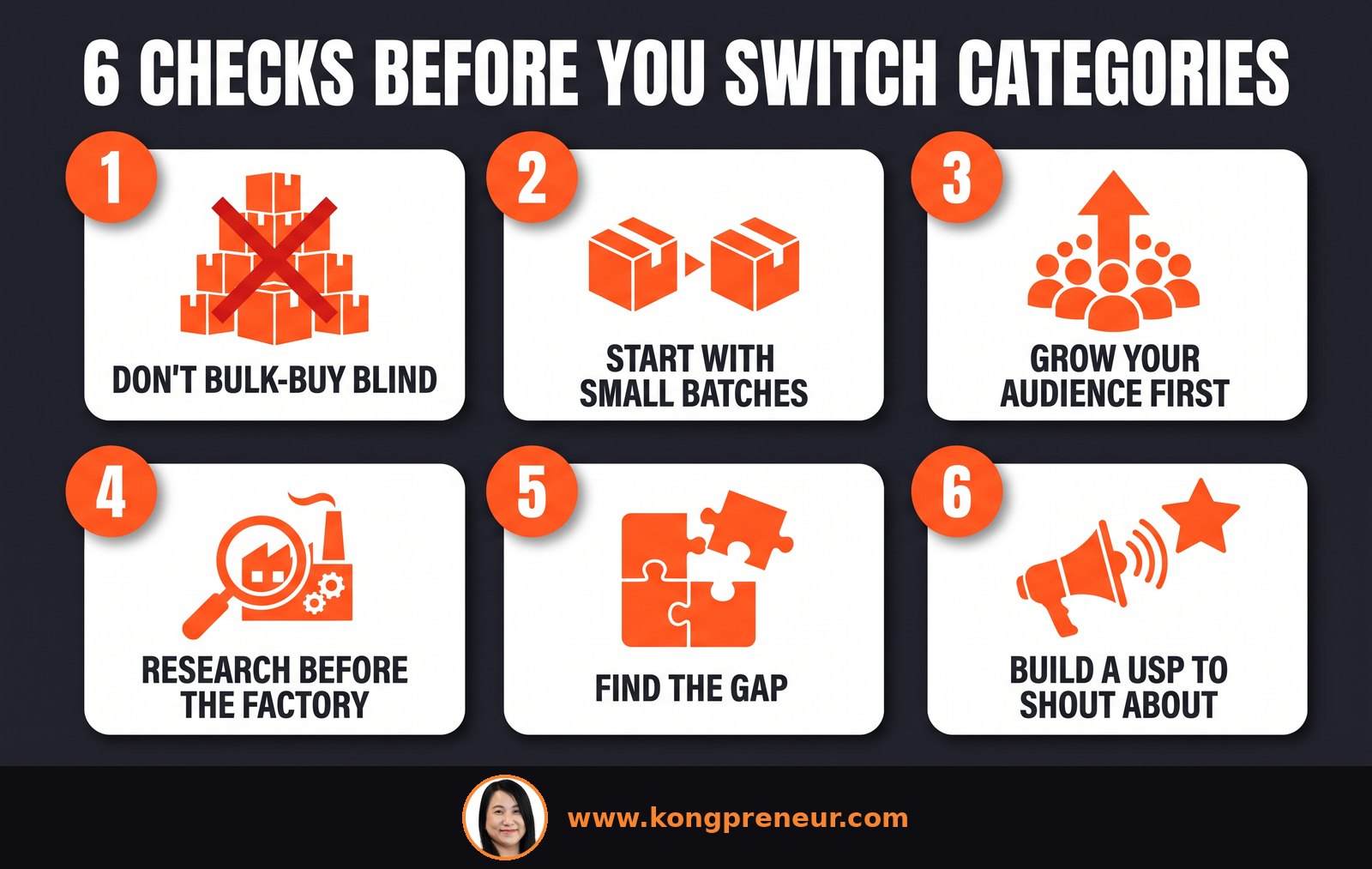
To be clear, I wasn't telling him food is a bad category. What worried me was jumping in blind: no experience in the new category, and committing to thousands of units of a brand-new product from day one. Moving from fashion to sambal is a completely different game.
There was another gap too. In his fashion business, his staff run the livestreams. He had never appeared on camera himself. Khairul Aming is an influencer, and his audience follows him personally. Copying the product without the audience behind it doesn't copy the result.
So here is what I told him to check before chasing a "better margin":
📌 Found this useful? Save this infographic or share it with a friend who sells online: WhatsApp · Facebook · Pinterest
He listened. Instead of stocking first, he started researching the market first. That one change protects his cash and gives a new product a much better chance of being one of the two that win.
Research doesn't need fancy tools. Start where your buyers already shop:
Let me be honest about the journey. Your first product may not be a winner, and that's fine if you started small. The early months are about testing, reading your sales data and adjusting your images, price and ads. When you find a product that moves, that's the moment to put more stock and more budget behind it.
There is no fixed timeline or guaranteed number. Results depend on marketing investment, consistency and product differentiation. A seller who budgets properly for ads, shows up with content and has a real USP will usually learn much faster than one who lists and waits.
Why do I share this so firmly? I've run my own e-commerce stores on Lazada, Shopee and TikTok for 12 years, and I manage Shopee accounts for many brands. My client and student experience covers fashion, home and living, health, beauty, food and personal care, so I've seen what happens when people pick products well, and what happens when they don't.
If you'd like someone to look at your category, your numbers and your plan with you, my private Shopee and Lazada training is customized to your level and your product category. A fashion seller and a health seller need very different tactics, and a brand needs a different plan from a reseller. We use your own data to decide what to grow next, and the class usually ends with a monthly sales growth plan you can act on.
To ask about a class, WhatsApp +60 19-801 9538 or email kong@kongpreneur.com. You can also find more of my e-commerce guides at www.kongpreneur.com.
Pick one category and a product with a real USP, not a generic item thousands of sellers already list. Start with small stock so you can test it before scaling.
Start small. I suggest around RM3k to RM5k of stock from a reputable supplier, so you keep cash aside for photos and ads.
Expect about 2 out of 10 products to win. That's normal, so test small, find your 2 winners and scale them.
Only after you research the market and test with small to medium batches. Never commit thousands of units to a category you have never sold in.
Aim for around 20% of your sales on ads, not less. Sellers who do well usually invest 15 to 20% of monthly sales in marketing and Shopee Ads.