There are no items in your cart
Add More
Add More
| Item Details | Price | ||
|---|---|---|---|

Fri Oct 30, 2026 · by Kong
The most common message I get from Shopee sellers isn't about what to sell. It's some version of this: "Kong, I switched on Shopee Ads, my budget vanished in a few days, and I still barely got any sales. Are ads a scam?"
They're not a scam. But they are badly misunderstood. Most sellers treat Shopee Ads like a switch — flip it on, sales pour in. When that doesn't happen, they either pour in more money and bleed faster, or they switch ads off completely and go back to waiting for "organic" sales that never really come. Both are expensive mistakes.
I've run my own stores on Shopee, Lazada and TikTok for over a decade, and I manage Shopee accounts for brands across fashion, home & living, health, beauty, food and personal care. In all of that, one pattern holds: the sellers who grow don't spend more on ads than everyone else — they spend smarter, and they fix the things ads can't fix first. This post is about exactly that: how much to put into Shopee Ads, where the money usually leaks, and how to make every ringgit work harder.
Here's the honest version. Shopee Ads buy you visibility. When a shopper searches a keyword or browses a category, your product can appear higher or in more places because you paid to be there. That's it. Ads bring more eyeballs and more clicks to your listing.
What ads do not do is make people want your product. They don't fix a confusing listing, a weak offer, or photos that don't explain anything. If your listing converts 1 in 100 visitors on its own, ads just send more visitors through that same door — and you pay for every click whether they buy or not. So the first question is never "how do I run ads?" It's "is my listing actually ready to receive paid traffic?"
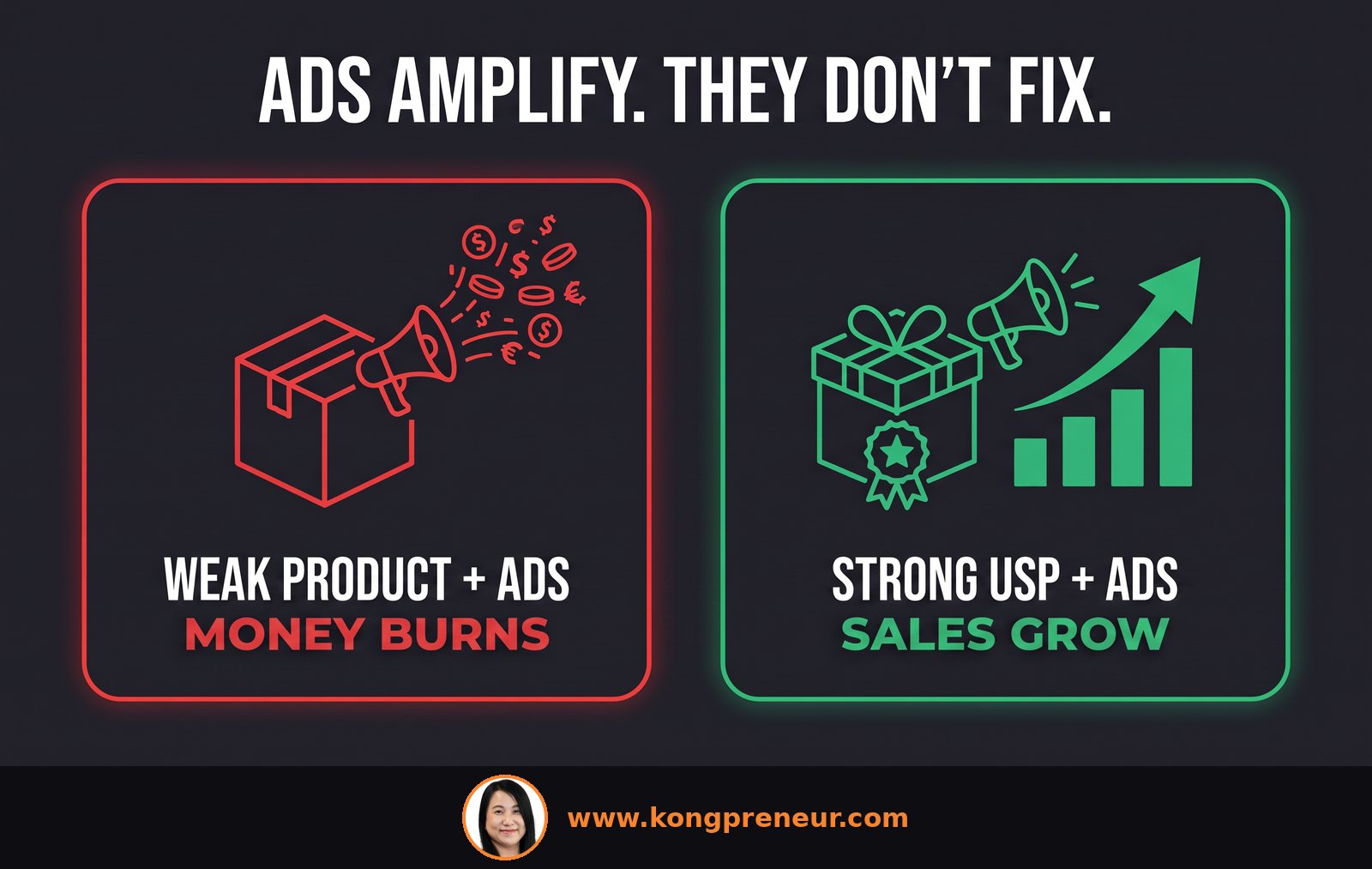
Think of Shopee Ads as an amplifier. Turn up the volume on something good and more people hear it. Turn up the volume on something broken and you've just paid to broadcast the problem to a bigger crowd.
📌 Found this useful? Save this infographic or share it with a friend who sells online: WhatsApp · Facebook · Pinterest
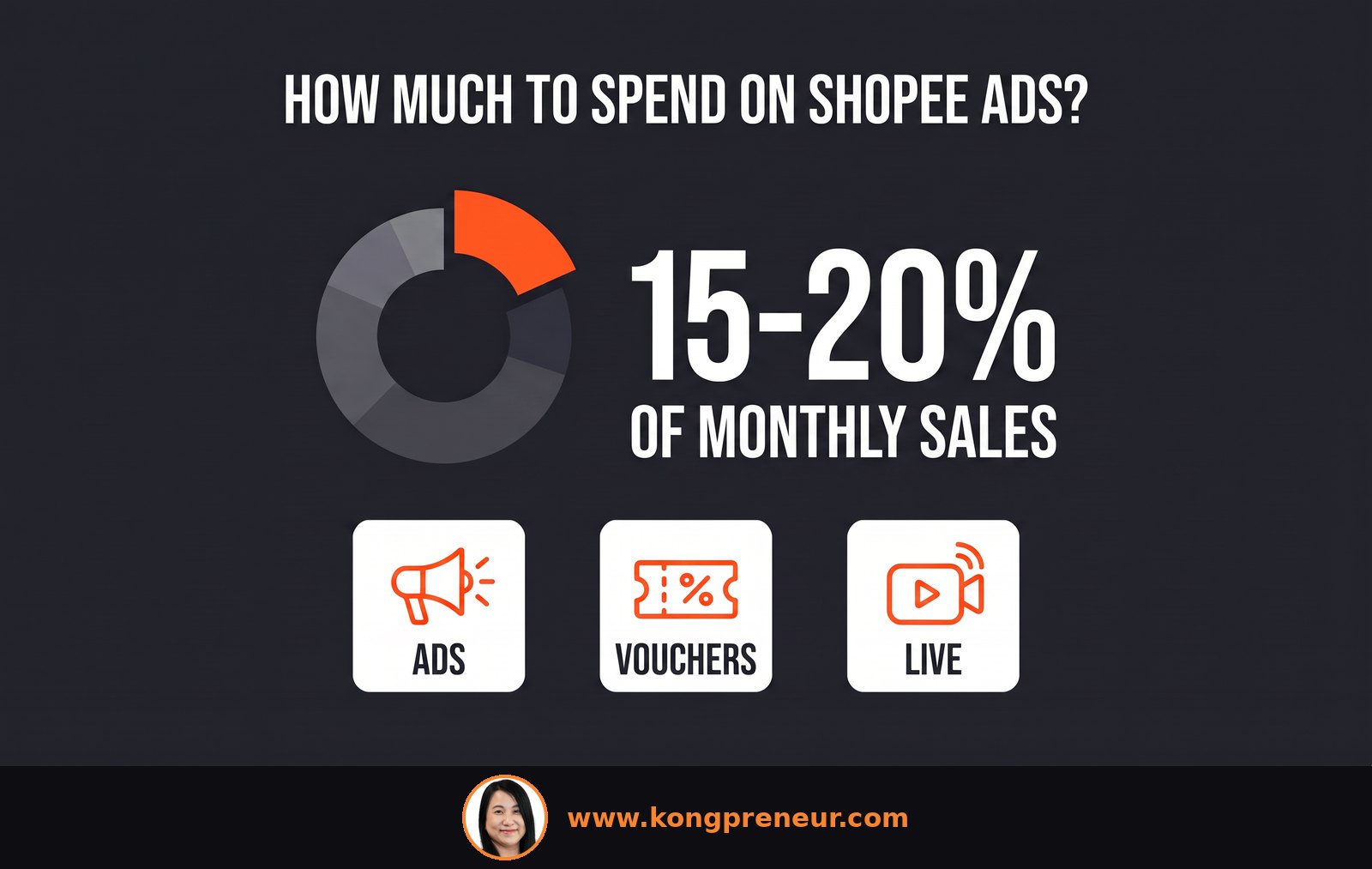
This is the number everyone wants, so here it is, from what I see in real accounts that are growing: healthy sellers put roughly 15–20% of their monthly sales back into marketing and ads. Not 2%, hoping for miracles. Not 50%, chasing revenue with no margin left. A sustained 15–20% is the range where ads tend to compound instead of just burning.
If you're brand new and nervous, you don't start at 20% of a number you don't have yet. Start with a small daily budget you can afford to lose while you learn, watch which keywords and products actually return money, and grow the budget as the winners prove themselves. Ads are not a one-time cost — they're an ongoing line item, the same as stock or packaging. Sellers who accept that early stop panicking every time the daily budget runs down.
One honest caveat before you treat 15–20% as a promise: it isn't one. Your results depend on your marketing investment, your consistency, and how differentiated your product is. Two sellers can spend the identical amount and get very different outcomes — and the difference usually isn't the ads. It's everything the ads are pointing at.
When a seller tells me their ads "don't work," I rarely look at the ad settings first. I look at the listing the ad is sending people to. Nine times out of ten, that's where the money is leaking.
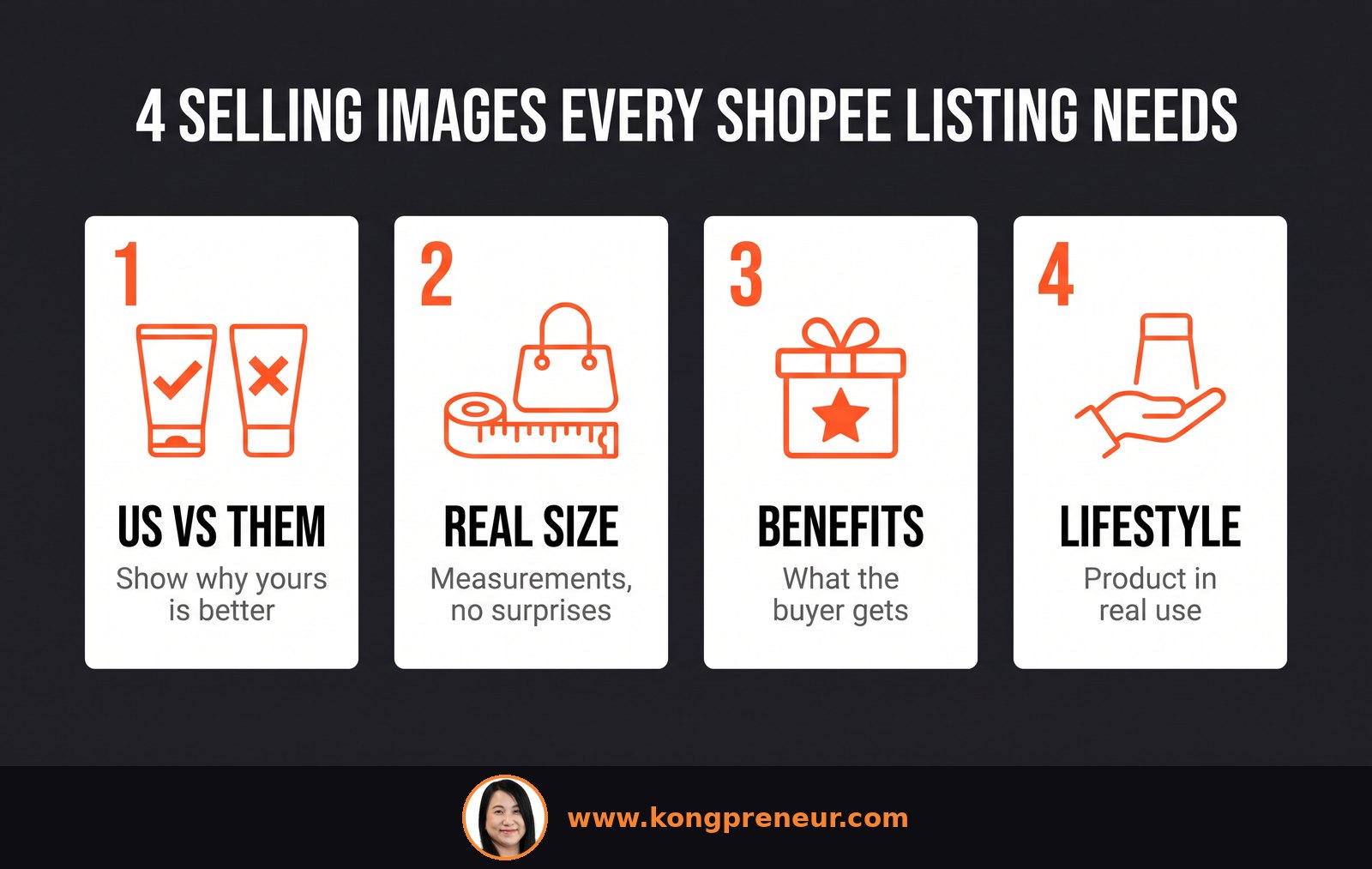
Shoppers today are lazy to read. They will not scroll through a long description to figure out whether your product is right for them — they decide in seconds, from the images. So your images have to do the selling. Before you spend another ringgit on traffic, make sure your main images answer the questions a buyer actually has:
📌 Found this useful? Save this infographic or share it with a friend who sells online: WhatsApp · Facebook · Pinterest
Do this before you scale ads, not after. An ad that sends 1,000 people to a listing that explains nothing is just a faster way to spend money. The same ad pointed at a listing that sells for you is where the growth comes from. If you want the fuller groundwork on this, I wrote a complete walkthrough in my guide to selling on Shopee.
📌 Found this useful? Save this infographic or share it with a friend who sells online: WhatsApp · Facebook · Pinterest
There's a deeper reason some sellers can never make ads profitable, and it has nothing to do with bidding. It's the product itself.
It used to be that the cheapest seller won. Not anymore. If you sell the exact same item, with the exact same copy-pasted photo from your China supplier, as thousands of other shops, then the only lever left is price — and that's a race to the bottom where whoever is willing to earn the least "wins." Pour ad spend into an undifferentiated product and you're simply paying to compete harder in a fight with no margin at the end of it.
The brands that actually grow do the opposite. They invest in making their product genuinely different — a real USP — and then they spend on content and awareness to shout, everywhere, why theirs is better. That's the setup where ads shine: a strong, differentiated product plus paid visibility equals real growth. A weak product plus ads just equals an expensive silence. Showing up everywhere through content and video is a big part of that awareness engine, which is why I treat video for business as part of the selling system, not a separate hobby.
When sellers ask me "which Shopee ad is the most important one?", I tell them that's the rookie question. The better question is: which tool haven't you used yet?
Shopee gives you a whole toolbox, and ads are only part of it. There are product ads, shop ads and live ads — and alongside them, livestream, Shopee Video, vouchers, gift-with-purchase, campaigns, flash sales and coins. Sellers who grow fastest aren't the ones who found the one magic ad type. They're the ones using all of these levers together, so that paid traffic lands on a shop already buzzing with offers and content. Ads bring the visitor; the rest of the toolbox is what turns that visitor into a repeat buyer. Leaving most of these switched off is leaving sales on the table.
My own specialty is data analysis — using what already happened in an account to decide what to do next. With ads, this is the whole game. After a week or two, your ads report tells you plainly which keywords and products are returning money and which are quietly draining it. The discipline is simple to say and hard to do: cut the losers without emotion, and move that budget into the winners.
Most sellers do the reverse. They leave underperforming ads running because they "might turn around," and they're too cautious to put more behind the products that are clearly working. Scaling isn't about spending more everywhere — it's about spending more where the data already proved it pays back.
If you take one thing from this: Shopee Ads are a cost of doing business, not a growth hack. Budget for them like you budget for stock. Point them at listings and products that are genuinely ready. Use them alongside the rest of Shopee's tools, not instead of them. And let the data — not your mood — decide where the money goes.
Done that way, ads compound. One of my students, a health & beauty brand I manage, grew from around RM8,000 to RM400,000 in monthly sales over 20 months — and paid marketing was a real part of that engine, pointed at a strong, differentiated product. Individual results vary — not a guarantee. Your own outcome will depend on your marketing investment, your consistency, and how different your product truly is. But the direction is clear: get the foundation right, then let ads amplify it.
Start with a small daily budget you can afford to lose while you learn. As you see which keywords and products return money, grow toward the 15–20%-of-monthly-sales range that healthy sellers tend to sustain.
Usually the ads are fine and the listing is the problem. If your images don't explain the product and its benefits at a glance, you're paying for visitors who bounce. Fix the listing before you scale the budget.
Waiting for purely organic sales is the myth that keeps sellers stuck. Sellers who grow invest in marketing. Ads are worth it when they point at a strong product and a listing that converts — not as a rescue for a weak one.
There's no single best one. Growth comes from using them together, and alongside Shopee's other tools — livestream, vouchers, campaigns, Shopee Video — so paid traffic lands on an active, offer-rich shop.
Read your ads report every week. Cut the keywords and products that aren't returning money, and move that budget to the ones that clearly are. Scale winners; don't babysit losers.
Free tutorials — including mine — will teach you the basics, but they can't see your account. Every Shopee seller's situation is different: your category, your level, your margins and your data all change what you should actually do with your ad budget. That's what my private Shopee & Lazada training is for — it's customised to your level and your product category, built around your real numbers, and it usually ends with a concrete growth plan rather than generic tips. If that's what you need, WhatsApp me at +60 19-801 9538 or email kong@kongpreneur.com, and have a look around kongpreneur.com while you're deciding.