There are no items in your cart
Add More
Add More
| Item Details | Price | ||
|---|---|---|---|

Thu Nov 5, 2026 · by Kong
Nobody wants to stake their name on a product with zero reviews. That one sentence explains why so many sellers reach out to big KOLs on TikTok Shop and get nowhere.
It stings, because the plan looked so sensible on paper: find a famous creator, send the product, watch the orders roll in. But when I look at how sellers approach affiliates, I see the same pattern again and again, across all my seller students. They start at the wrong end of the ladder.
This guide is for Malaysian sellers with a new product or a new brand on TikTok Shop who want affiliates to carry some of the selling. I'll show you why big names ignore you at the start, the three mistakes that keep you stuck, and the order that works better: build your own pool first, and let the bigger names come to you.
Let's clear up the expectation first, because this is where the disappointment starts. A TikTok Shop affiliate creates content that promotes your product and grows your brand's reach. That is their whole job.
Notice what is missing from that sentence. An affiliate is not a guaranteed sales machine. Many sellers approach affiliates thinking they will get massive sales straight away, and that belief drives every mistake that follows.
Now look at it from the affiliate's side. They earn when people buy, so they want easy conversion and easy money. Before they make a video for you, they look at two things on your product: the number of items sold and the 5-star reviews. A product with a strong sold count and good reviews looks like a safe bet. A product with nothing looks like a wasted afternoon of filming.
This is also why big KOLs rarely pick up a brand new, zero-review item, unless it already belongs to a famous brand. It isn't personal. They are protecting their own name and their own income, the same way you protect your margin.
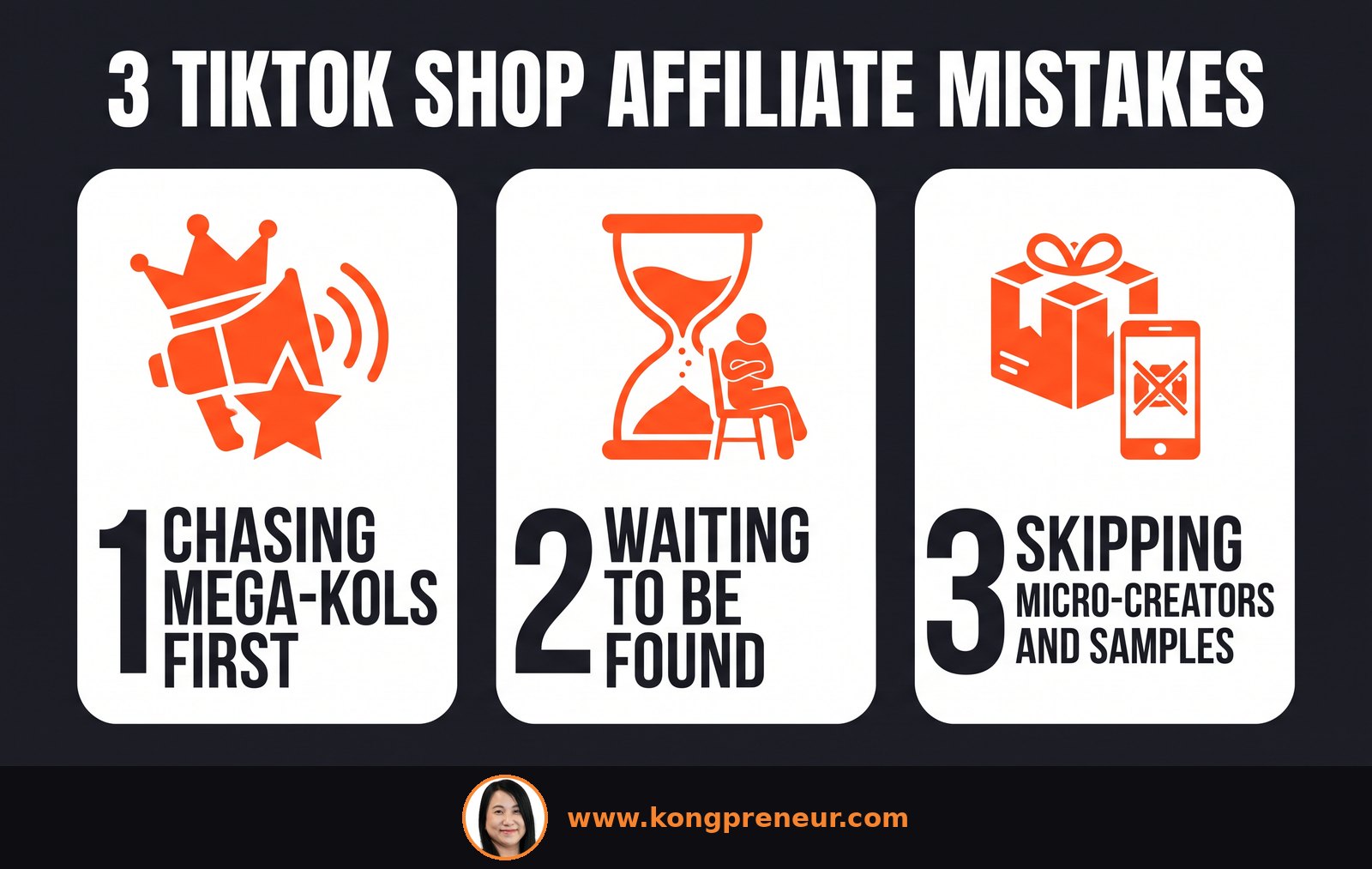
I watch these three play out across all my seller students. If you are doing any of them, you are not alone, and all of them can be fixed.
📌 Found this useful? Save this infographic or share it with a friend who sells online: WhatsApp · Facebook · Pinterest
Going straight to the biggest names feels like the shortcut. In practice it is the slowest route, because you are asking for the one thing a new product cannot offer yet: proof that it sells. All that chasing leaves your product page looking exactly the same.
Some sellers list the product, open it to affiliates and sit back. I understand the hope, but it is the same myth I talk about on Shopee: that simply putting a product on a platform will bring the sales in by itself. A new brand cannot just appear and get discovered. If you aren't creating any movement on your own product, an affiliate has no reason to notice it.
Smaller creators feel less exciting than a famous name, so sellers jump over them. But this is the stage where real proof gets built. Skip it and you have nothing to show the bigger creators later, which sends you straight back to mistake one.
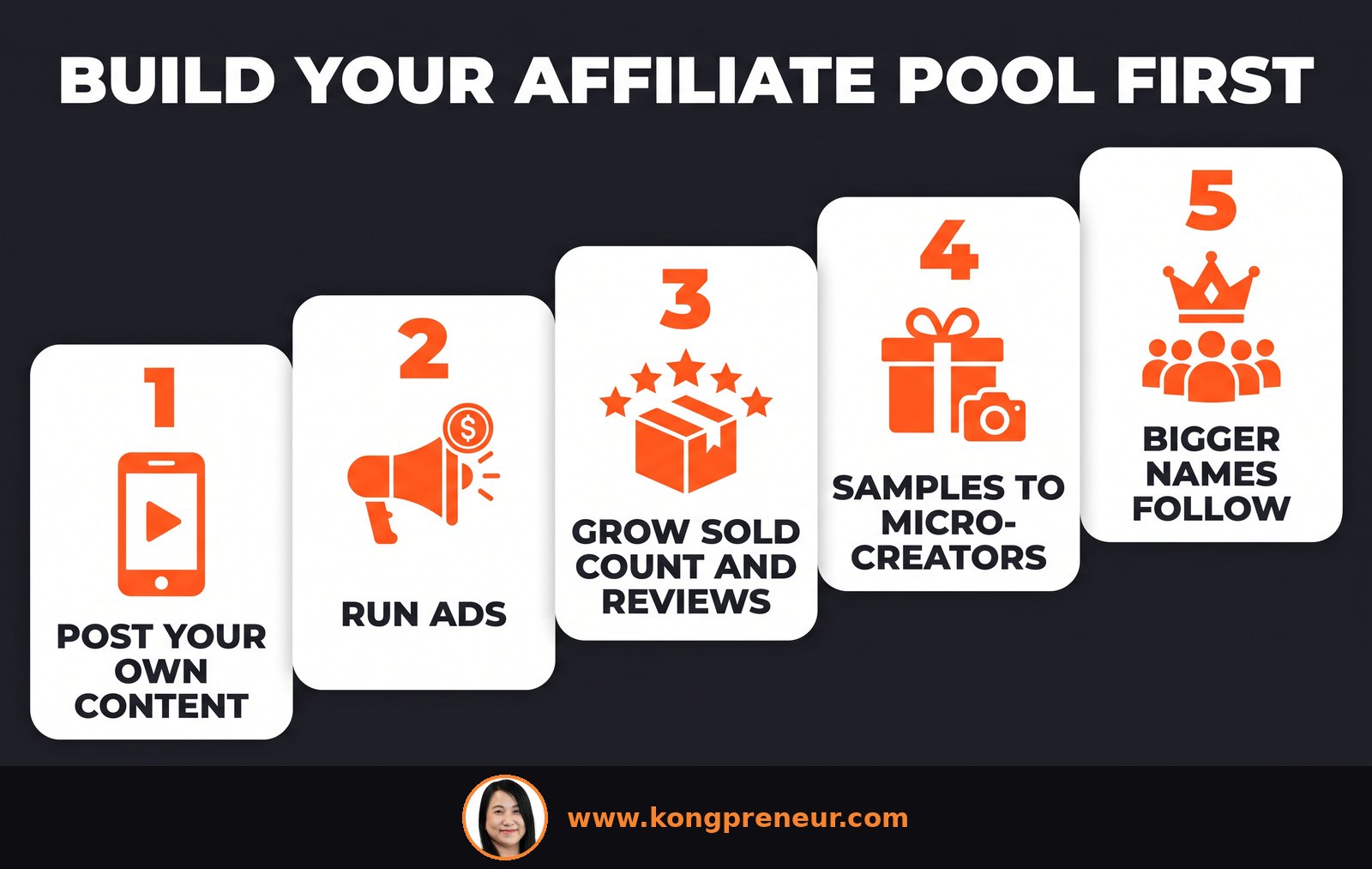
The big names only show up once the pool is already there. So your job is to fill the pool, in this order:
📌 Found this useful? Save this infographic or share it with a friend who sells online: WhatsApp · Facebook · Pinterest
You have to build your own hype before anyone else will join in. That means posting more content yourself instead of waiting for a creator to do it for you.
Keep it simple. In my video on getting 1,000 TikTok followers, I share the approach I recommend: post every day, give tips and value your target audience actually wants, and just talk to the camera instead of relying on Canva-style posts. Your content also needs a reason to exist, so shout about what makes your product different. If you sell exactly what thousands of other sellers sell, with the same supplier photo, there is very little to talk about and very little for an affiliate to pitch.
This is the step sellers try to skip, and it is the one that moves the numbers fastest. For a new brand, paid is the fastest way in. Ads get your product in front of buyers before any creator has heard of you, and every sale they bring adds to the sold count affiliates are looking at.
How much? On Shopee, the sellers who do well put roughly 15–20% of their monthly sales into marketing and ads. For new sellers finding their winning product, my advice is 20% of sales on ads, not less. I break down that thinking in my post on how much to spend on Shopee Ads, and the same rule applies here: ads amplify a good product, they don't rescue a weak one.
Steps one and two are really in service of this one. Your product page is your pitch to affiliates. Every unit sold and every 5-star review makes it an easier yes.
Open your own product page and pretend you are a creator deciding whether to spend an afternoon on it. Would you risk your name on it today? If the honest answer is no, keep working on this step before you approach anyone.
Once the reviews come in, micro-creators start saying yes. This is when samples are worth sending, because the creator can see your product already sells.
I don't have a magic number of samples for you. What matters more is the order: proof on the product first, then creators. Their videos then add more reach and more proof, and the pool keeps growing.
After more creators come in, the bigger ones naturally come too. By then your product is no longer an unknown, so saying yes is an easier call. You stop chasing them because the pool is doing the work.
Here is what we have seen ourselves: once we had more than 500 units sold, affiliate numbers grew 20–30% month by month.
Please treat that as a marker from our own experience, not a promise. Your numbers will be different. Results depend on marketing investment, consistency and product differentiation. Individual results vary, and this is not a guarantee.
The lesson behind the number matters more than the number itself. Affiliate growth came after the units sold, not before. Most sellers try to reverse that order, and that is why they stay stuck.
The early stretch is the hardest, so go in with your eyes open.
If you are already sitting on a strong product, the good news is that none of this needs a famous friend. It needs the right order and steady work. I've run my own stores on Lazada, Shopee and TikTok for 12 years, and the sellers who keep going in the right order are the ones who give themselves a real chance.
Usually because it has few units sold and few reviews. Affiliates look at both before making content, because they want easy conversion.
Not first. Big KOLs rarely pick up a brand new, zero-review item unless it belongs to a famous brand, so build sales and reviews, then work with micro-creators.
There is no fixed rule, but once we had more than 500 units sold, we saw affiliate numbers grow 20–30% month by month. Individual results vary and this is not a guarantee.
Not at the start. Ads and your own content are what push up units sold and 5-star reviews, and those are what bring affiliates in.
Once reviews start coming in. That is when micro-creators start saying yes, and their content becomes the proof that attracts bigger names.
The order above works as a general path, but your category, your level and your numbers change what you should do first. Brands can't be taught the same strategies as resellers, and a fashion seller's tactics differ a lot from a health seller's. That's why my private Shopee & Lazada training is customised to your level and product category, and it usually ends with a growth plan for your business. If that's what you need, WhatsApp me at +60 19-801 9538 or email kong@kongpreneur.com, and have a look around kongpreneur.com while you're deciding.